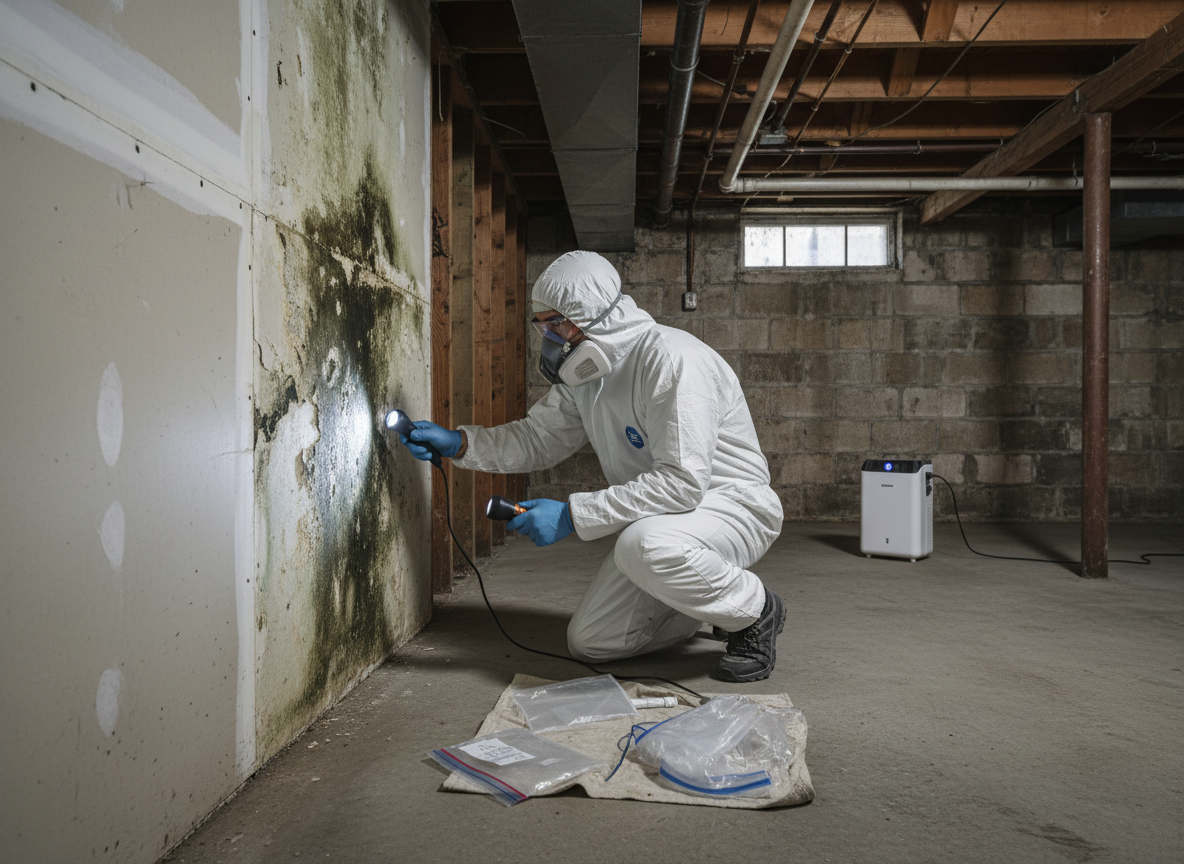
Basement mold inspection in Midway City homes requires attention to the mild Mediterranean climate that keeps daytime temperatures moderate but allows nighttime condensation to form on cooler foundation walls. Properties along Beach Blvd and in surrounding neighborhoods often feature older concrete foundations that can draw moisture from irrigation runoff common in nearby Westminster and Garden Grove. Inspectors use moisture meters and thermal imaging to locate hidden dampness behind drywall or under flooring before visible growth appears.
Edge cases frequently involve crawlspace transitions where soil contact meets slab edges, creating capillary action that pulls water upward during rare heavy rains. Air sampling is performed at multiple heights because spores settle differently in still basement air compared to upper levels. Any inspection must document HVAC ductwork that may route through the space, since even small leaks can distribute spores throughout the house.
Code considerations include ensuring proper ventilation openings remain unobstructed, as Orange County requirements for habitable spaces can affect how inspectors assess airflow. Homeowners are advised against disturbing suspected areas until testing confirms the extent, since improper cleaning can spread spores to adjacent rooms. Reports include photos, moisture readings, and specific locations so remediation crews know exactly where to focus.
Technician insight
In Midway City, the thing that catches most people out with Basement mold inspection is how the mild Mediterranean climate lets irrigation water from neighboring Garden Grove yards seep under older slab edges along Beach Blvd without obvious puddles, so the mold stays hidden until we pull baseboards.
Hidden moisture behind finished walls
A Midway City homeowner noticed a faint musty smell after winter rains. We mapped moisture along the north foundation wall and found elevated readings behind drywall installed over an older concrete stem wall. Air samples confirmed elevated spore counts. The report outlined the exact sections needing removal and directed the owner to a remediation crew familiar with local soil conditions.
How it works
- 1
Initial Walkthrough
Technician examines all accessible basement areas for visible staining, musty odors, and water stains on walls or floors.
- 2
Moisture Mapping
Readings are taken on concrete, drywall, and wood using calibrated meters to identify active damp zones.
- 3
Air and Surface Sampling
Samples are collected from multiple locations and sent for lab analysis to identify mold types and concentrations.
- 4
Report and Recommendations
Findings are compiled into a written report with photos and next-step guidance for any confirmed issues.
Pricing
Pricing varies by basement size, access difficulty, and number of samples required.