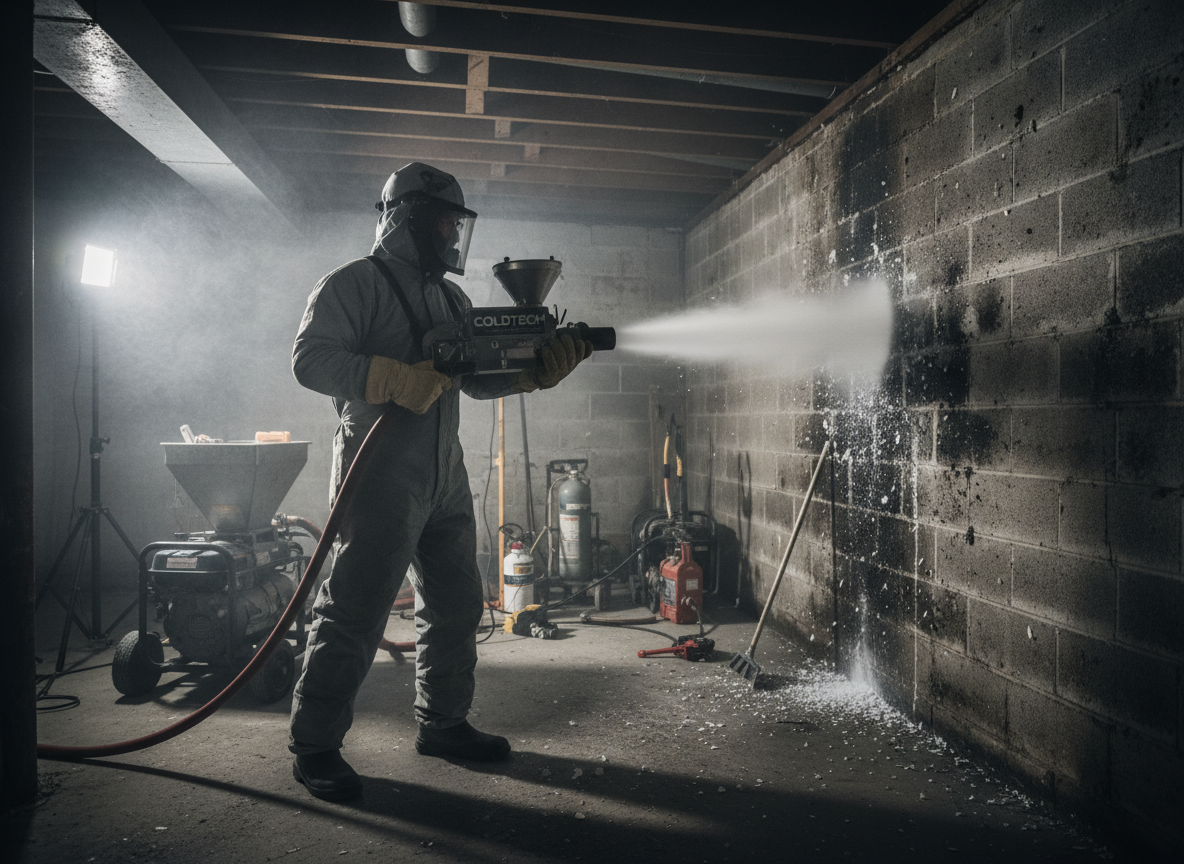
Dry ice blasting propels solid CO2 pellets at mold colonies on wood, concrete, and stucco surfaces common in Midway City homes built before 1980. The process sublimes on contact, lifting growth without abrading substrate or leaving residue that could feed future colonies. In Orange County properties near Garden Grove, where irrigation runoff and occasional heavy winter rains penetrate older stucco, technicians must first map hidden moisture behind walls using infrared before blasting begins.
Edge cases include attics with fiberglass insulation saturated from roof leaks and crawl spaces under raised foundations where soil moisture from the mild Mediterranean climate keeps relative humidity elevated year-round. Blasting works only after source correction; otherwise spores reappear within months. Local building codes in Midway City require containment and negative air during any remediation exceeding ten square feet, so crews set up sealed chambers and HEPA filtration before starting the dry ice equipment.
Homeowners often mistake surface staining for the full extent of growth. Blasting reveals the true depth because the kinetic energy dislodges embedded hyphae without introducing water that could travel into adjacent drywall. Technicians carry spare nozzles sized for tight joist bays found in 1960s tract homes throughout the area, preventing incomplete coverage that leaves viable mold behind.
Seasonal Considerations
Mild temperatures in Midway City mean mold activity does not spike dramatically with seasons, yet winter storms can push water under eaves and into wall cavities that stay damp for weeks. Scheduling blasting after roof repairs prevents repeat visits.
Technician insight
In Midway City the thing that catches most people out with dry ice blasting mold is the single-story stucco homes near Beach Boulevard whose wall cavities stay damp from poor grading and the mild Mediterranean climate; homeowners see surface spots and think blasting alone fixes it, but without fixing the irrigation or roof edge first the mold returns inside the same year.
Attic Mold After Roof Leak
A Midway City homeowner noticed dark staining on ceiling joists after winter rain. Inspection found active growth on plywood sheathing from a slow roof leak. Dry ice blasting removed the colonies without saturating insulation. After source repair the attic passed clearance testing and remained dry through the next season.
How it works
- 1
Inspection and Moisture Mapping
Technicians use moisture meters and thermal imaging to locate all affected areas in Midway City homes before any blasting occurs.
- 2
Containment Setup
Plastic barriers and negative air machines isolate the work zone to keep spores from migrating into living spaces common in nearby Westminster properties.
- 3
Dry Ice Blasting
CO2 pellets are applied at controlled pressure to remove mold from wood, stucco, and concrete without chemicals or added moisture.
- 4
HEPA Vacuum and Clearance
All loosened material is captured and the area is cleared with independent testing before barriers come down.
Pricing
Cost depends on square footage treated, access difficulty in older Midway City construction, and whether additional moisture source repairs are needed.