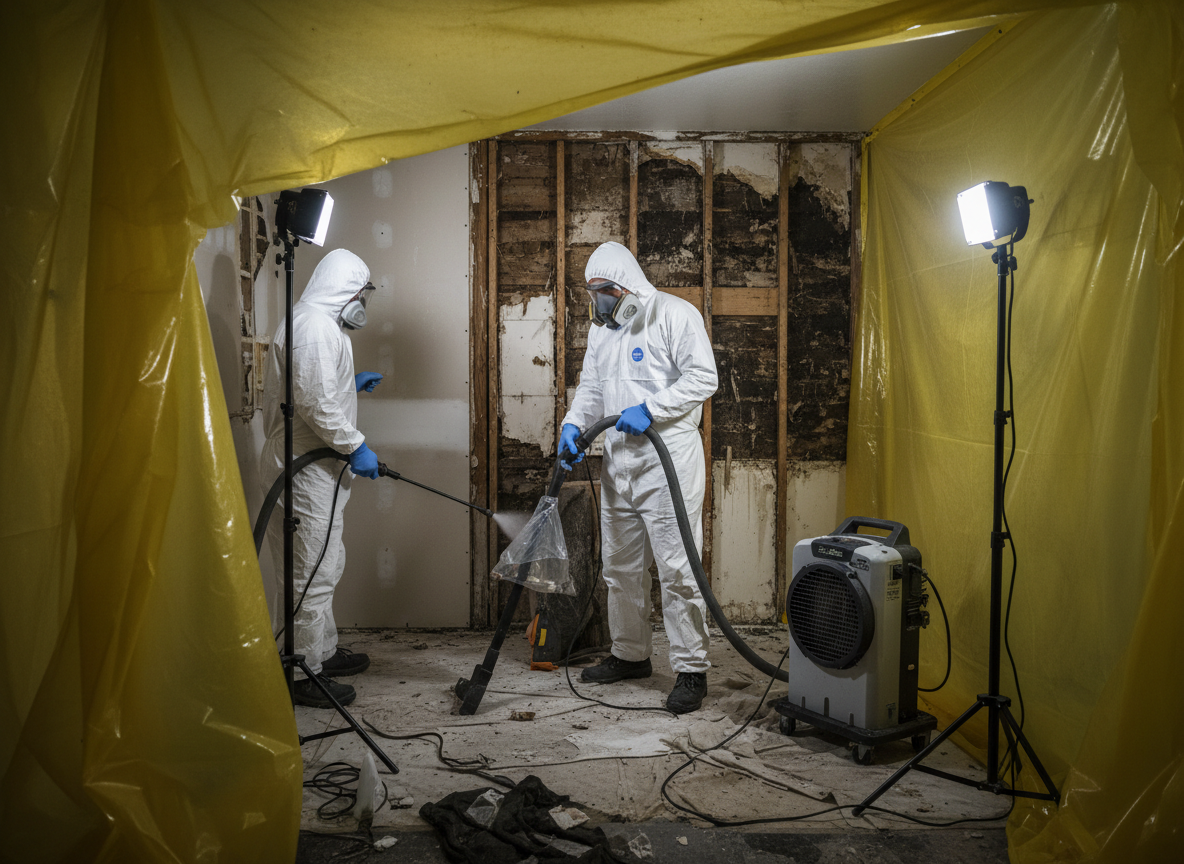
Midway City homes often sit on older foundations near Westminster and Garden Grove, where the mild Mediterranean climate brings winter rains that seep into crawl spaces and attics. These conditions allow hidden mold colonies to form behind drywall or under flooring when leaks go unnoticed for weeks. Technicians must account for the region's sandy soils that retain moisture longer than inland areas, requiring extra drying time before any rebuild work begins.
Remediation crews working in this part of Orange County routinely deal with stucco exteriors and slab-on-grade construction that trap humidity inside walls. Standard containment protocols expand here because shared walls in duplexes and small lots increase the chance of cross-contamination to neighboring units. Every job includes moisture mapping with meters calibrated for local humidity swings between coastal fog and inland heat.
After removal, final clearance testing follows California guidelines for habitable spaces rather than generic national standards. Crews pay special attention to HVAC ducts common in 1960s-1980s tract homes throughout Midway City, as spores travel easily through these systems during the dry summer months when windows stay closed.
Technician insight
In Midway City, the thing that catches most people out with mold remediation near me is water trapped under the slab in pre-1980 homes after winter rains; the mild Mediterranean climate keeps soil damp longer than owners expect, so the mold returns within months if the source under the concrete is never addressed.
Bathroom Leak in Garden Grove Duplex
A resident in a Garden Grove duplex noticed a persistent musty smell after several days of rain. Inspection revealed mold growing behind the shower wall where a slow pipe leak had soaked the drywall and floor joist shared with the neighboring unit. The team contained both units, removed the affected materials, dried the cavity, and treated the wood. Follow-up testing showed levels returned to normal and no further odor was reported.
How it works
- 1
Site Inspection
Technicians arrive within hours, use moisture meters and borescopes to locate all affected areas, and document visible and hidden growth.
- 2
Containment Setup
Plastic barriers and negative air machines isolate the work zone to prevent spores from spreading to unaffected rooms or neighboring properties.
- 3
Removal and Cleaning
Porous materials are removed, non-porous surfaces are treated with EPA-registered solutions, and HEPA vacuuming follows in all impacted zones.
- 4
Drying and Clearance
Industrial dehumidifiers run until moisture levels match surrounding unaffected areas, then air samples confirm the space meets clearance criteria.
Pricing
Pricing varies with the size of the affected area, accessibility, and whether HVAC cleaning is required.